Case Study: How an Emoji Domain Changes What Viewers Notice
A practical look at how a wine-glass emoji domain can make campaign links faster to recognize, easier to remember, and more useful across labels, QR codes, social bios, and tasting-room moments.
- case study
- emoji domains
- wine marketing
- web3
- qr codes
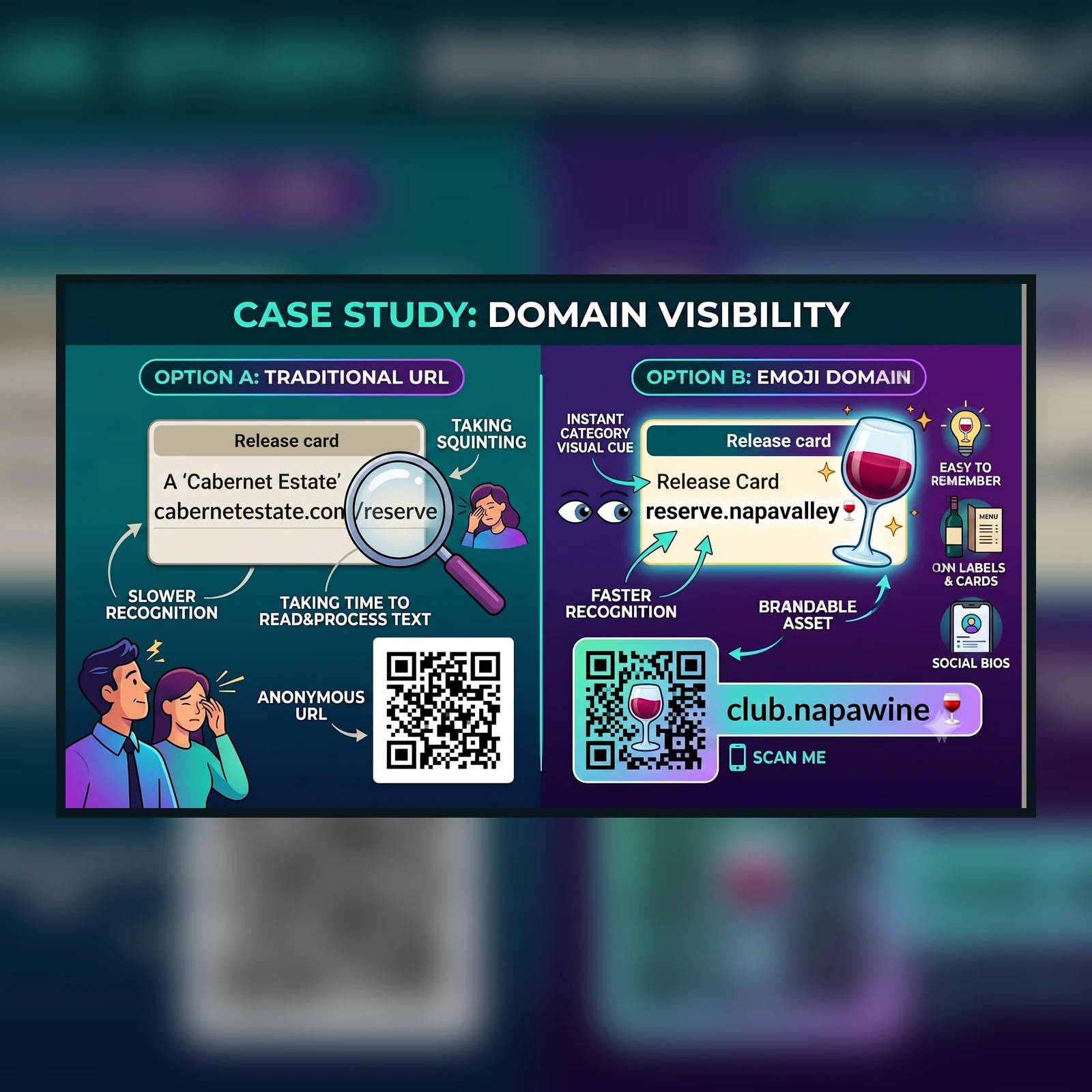
Case study: how an emoji domain changes what viewers notice
Wine marketing often has only a second to earn attention. A customer sees a shelf talker, scans a tasting-room menu, glances at a bottle label, or scrolls past a social bio. In that moment, the job of a domain is not only to be technically correct. It has to be seen, understood, and remembered.
That is where an emoji domain changes the viewing experience.
The scenario
Imagine two campaign links printed on a release card for a limited Cabernet allocation:
Option A: cabernetestate.com/reserve
Option B: reserve.napavalley🍷
Both can lead to the same Web2 landing page. Both can be connected to a QR code. Both can support tracking and conversion. But they do not create the same first impression.
The traditional URL asks the viewer to read and parse the address. The emoji domain gives the viewer a visual cue before the words are fully processed. The wine glass tells them the category instantly: this is a wine link, from a wine brand, attached to a wine moment.
What changes for the viewer
1. Recognition happens faster
People process visual signals quickly. The 🍷 glyph acts like a miniature category marker inside the address itself. Before the viewer evaluates the words, they recognize the domain as connected to wine.
That makes the link easier to understand in low-attention environments: a crowded tasting room, a retail shelf, an event table, a postcard, or a fast-moving social feed.
2. The address becomes part of the brand
Most links feel like infrastructure. An emoji domain feels more like a brand asset. It gives the winery a visual handle that can live across campaigns without needing extra explanation.
A name like tasting.sonomavalley🍷 is not just a destination. It is a compact brand message: tasting, Sonoma Valley, wine.
3. Recall improves after the moment passes
A customer may not remember a full URL after leaving the tasting room, but they are more likely to remember the structure of a short phrase plus a wine glass. The emoji creates a mental hook.
That matters because wine purchases often happen later: after a visit, after dinner, after seeing a bottle at a friend's house, or after revisiting a release email.
4. QR codes gain a readable companion
QR codes are useful, but they are visually anonymous. A printed emoji domain beside the QR code tells the viewer where the scan is going and why it matters.
Instead of a generic square code, the campaign can show:
club.napawine🍷
That gives the scan a promise: this leads to the wine club, and it belongs to the wine brand.
5. The link feels early and distinctive
Wine brands compete in a crowded visual world. Labels, tasting rooms, AVA names, varietals, and social posts all fight for attention. A Web3 emoji domain gives the brand a small but noticeable point of difference.
It signals that the winery is willing to try a more modern, memorable, and ownable form of digital identity.
The marketing outcome
The value is not that every customer understands Web3. The value is that more customers notice the address, understand the category, and remember the path back.
A Web3 emoji domain can support practical Web2 outcomes today:
- More memorable calls to action on labels and cards
- Clearer QR code campaigns
- Better recall after tastings and events
- Stronger visual identity in social bios
- Defensive ownership of important campaign names
- A future-facing brand story that is easy to explain
How a winery could use it
A winery does not need to replace its current website. It can keep its existing .com as the main corporate address and use emoji domains as campaign front doors.
Examples:
reserve.napavalley🍷redirects to an allocation pageclub.sonomawine🍷redirects to wine club signupvisit.sonomavalley🍷redirects to tasting reservationsharvest.napawine🍷redirects to a seasonal release story
Each domain becomes a simple visual bridge from attention to action.
Bottom line
In a sea of .com sameness, an emoji at the end of your address signals one thing instantly: wine. It is a logo, a category, and a hook wrapped in a single glyph.
For wineries, that means the domain is not just where customers go. It is part of what customers notice.